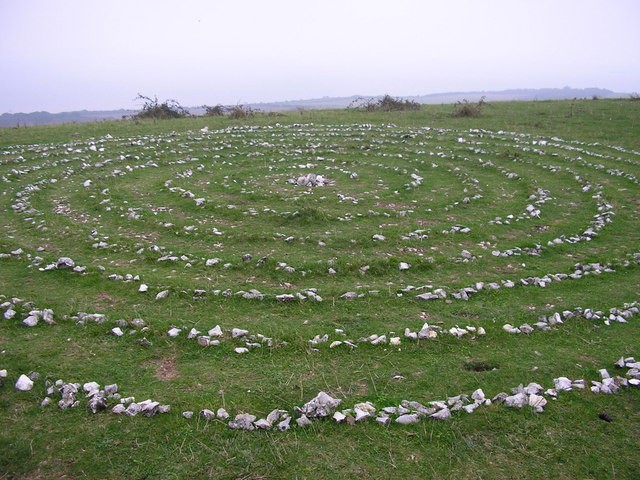
A finger labyrinth reflection gives your attention somewhere modest to travel. Instead of walking a large outdoor design, you follow a small printed or drawn path with a finger. I feel its usefulness lies in the pace it offers: one line, one turn and no requirement to produce an extraordinary experience before returning to your day.
Choose a simple, clearly visible design with a continuous route toward a center. You can use a personal sketch rather than buying a special object. If following lines is uncomfortable, trace a broad curve you can see easily or use your gaze instead. This is an optional attention exercise, not a test of dexterity or spiritual sensitivity.
Give the path a manageable purpose
Before beginning, give the practice a limited purpose. “I want a few quiet minutes before choosing what to do next” is enough. A question such as “Will this person return?” can encourage you to turn every pause into an answer. Let the path support your ability to consider a question rather than pretending it can settle another person’s intentions.
Move along the line at a comfortable speed. When you notice yourself rushing toward the center, slow down without correcting yourself sharply. When your mind wanders, return to the point where your finger rests. You do not have to restart. An interruption does not spoil the exercise, and reaching the center is not a reward for having no thoughts.
Notice without decoding
At the center, stop briefly and notice one thing: perhaps a sentence you keep repeating, an impatient feeling or the sound outside the room. Then follow the route outward. Avoid assigning automatic meanings to a wrong turn, a shaky line or an accidental shortcut. The physical drawing is not sending you a coded warning about your future.
When you finish, write a single observation and a practical next action. You might have noticed how urgently you wanted certainty, then choose to draft a question before having a conversation. The observation belongs to reflection; the action belongs to ordinary life. Keeping those separate makes the exercise useful without giving it authority it has not earned.
Keep the tool in proportion
Try the same design twice before deciding whether it suits you. If it feels tedious, leave it behind without treating that preference as resistance to growth. A spiritual tool should serve your attention. You do not owe a piece of paper a breakthrough, and you do not need to turn a quiet practice into another performance.
Explore private readings with Melissa.
Photograph and attribution
Real photograph of an outdoor stone labyrinth, used as a visual reference for the path pattern; not a finger labyrinth or a client practice. Photo: Thomas Wood; CC BY-SA 2.0. Display copy resized. Original photograph and rights record. License terms.

